









For decades, the conversation around hypertension has been dominated by one villain: salt. Doctors warn patients to put down the shaker, food labels boldly proclaim “low sodium,” and public health campaigns urge us to season with herbs instead. Yet despite these efforts, hypertension continues to affect nearly half of American adults, according to the CDC’s data on high blood pressure. Something isn’t adding up.
What if salt is only part of the story? Emerging research—and a growing chorus of holistic practitioners—suggests that insulin resistance may be the more powerful, and more overlooked, driver of high blood pressure. Let’s explore both perspectives, why they matter, and what you can practically do about it.
Understanding Hypertension: A Quick Refresher
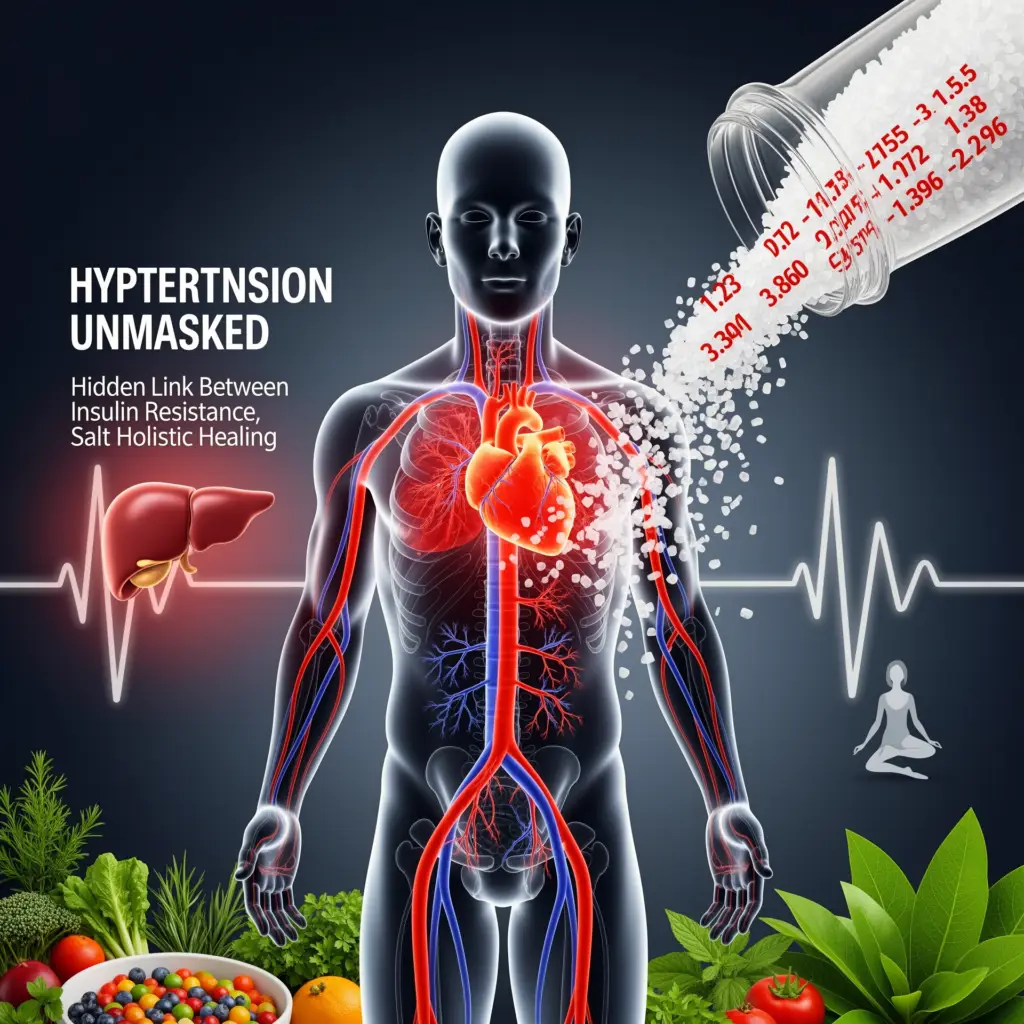
Hypertension, or chronically elevated blood pressure (typically defined as readings above 130/80 mmHg per the 2017 ACC/AHA guidelines), is often called the “silent killer.” It increases the risk of stroke, heart attack, kidney disease, and cognitive decline. Conventional medicine identifies primary (essential) hypertension—accounting for about 90–95% of cases—as having no single identifiable cause, while secondary hypertension stems from a specific condition like kidney disease or hormonal disorders.
The standard treatment toolkit includes diuretics, ACE inhibitors, beta-blockers, and lifestyle modifications focused heavily on the DASH diet and sodium restriction. These approaches save lives—but they often manage symptoms without addressing the metabolic root.
The Salt Story: How Much Truth Is in the Shaker?
The Allopathic View
The link between sodium and blood pressure is well-documented. Studies like the landmark INTERSALT study (Stamler, 1997) and the DASH-Sodium trial (Sacks et al., NEJM, 2001) demonstrated that reducing sodium intake lowers blood pressure—particularly in salt-sensitive individuals. The American Heart Association recommends no more than 2,300 mg of sodium per day, ideally closer to 1,500 mg.
The Nuance Most People Miss
Not everyone responds to salt the same way. Research suggests only about 50% of hypertensive individuals are truly “salt-sensitive” (Weinberger, Hypertension, 1996). For the other half, drastically cutting sodium yields minimal blood pressure benefit—and may even cause harm. A meta-analysis published in The American Journal of Hypertension (Graudal et al., 2014) found that very low sodium intake was associated with increased mortality, hinting at a U-shaped relationship between sodium and health.
In other words, salt matters—but it’s not the universal culprit it’s been made out to be. For more on sugar’s underrated role, see our breakdown of what eating too much sugar does to your body.
The Insulin Resistance Connection: The Real Hidden Driver?
What Is Insulin Resistance?
Insulin resistance occurs when cells stop responding efficiently to insulin, the hormone responsible for shuttling glucose from the bloodstream into cells. The pancreas compensates by pumping out more insulin, leading to chronically elevated insulin levels (hyperinsulinemia). Over time, this drives type 2 diabetes, weight gain, and—critically—hypertension.
How Insulin Drives High Blood Pressure
Several mechanisms link insulin resistance to hypertension:
- Sodium retention by the kidneys. Insulin signals the kidneys to retain sodium and water, increasing blood volume and pressure (DeFronzo, Diabetologia, 1981). Ironically, this means insulin resistance can make you behave as if you’re consuming too much salt—even when you’re not.
- Sympathetic nervous system activation. High insulin levels stimulate the “fight or flight” response, raising heart rate and constricting blood vessels (Landsberg, Journal of Hypertension, 2001).
- Endothelial dysfunction. Insulin resistance impairs the production of nitric oxide, the molecule that helps blood vessels relax and dilate (Kim et al., Circulation, 2006).
- Vascular smooth muscle proliferation. Chronically elevated insulin promotes thickening of blood vessel walls, increasing peripheral resistance.
The Evidence
A pivotal 1987 paper by Ferrannini and colleagues in The New England Journal of Medicine demonstrated that essential hypertension is frequently accompanied by insulin resistance—even in lean, non-diabetic patients. Subsequent research, including work by Dr. Gerald Reaven (who coined “Syndrome X,” now known as metabolic syndrome), reinforced that insulin resistance is a foundational driver of cardiovascular disease.
More recently, a 2018 review in Current Hypertension Reports (Mancusi et al.) confirmed that insulin resistance is both a cause and consequence of hypertension, creating a vicious feedback loop.
Why the Salt-Insulin Connection Matters
Here’s where the two narratives merge: insulin resistance amplifies salt sensitivity. When insulin levels are high, the kidneys hold on to sodium more aggressively. So a person with insulin resistance eating a moderate-salt diet may experience the same blood pressure spike as a metabolically healthy person eating a high-salt diet.
This explains why some people improve dramatically on low-sodium diets while others see little change. It’s not the salt alone—it’s the metabolic terrain receiving the salt.
The Holistic Perspective: Addressing the Root
From a holistic health standpoint, treating hypertension means treating the whole metabolic picture, not just the blood pressure number. Here’s how:
1. Reduce Refined Carbohydrates and Sugar
This is arguably more important than reducing salt for most people with hypertension. A 2014 review in Open Heart by DiNicolantonio and Lucan argued that added sugars, particularly fructose, may pose a greater risk for hypertension than sodium. Cutting refined carbs lowers insulin levels, which in turn helps kidneys release retained sodium and water.
2. Prioritize Whole Foods Rich in Potassium and Magnesium
The sodium-potassium balance matters more than sodium alone. Foods like leafy greens, avocados, sweet potatoes, and bananas help counteract sodium’s effects. Magnesium-rich foods (pumpkin seeds, dark chocolate, almonds) support vascular relaxation. The DASH diet inadvertently works partly because it boosts these minerals. Explore our list of top foods that increase metabolism and burn fat for additional metabolic-friendly options.
3. Move Your Body Daily
Exercise improves insulin sensitivity within hours and lowers blood pressure long-term. A meta-analysis in Hypertension (Cornelissen & Smart, 2013) found that aerobic exercise reduced systolic BP by an average of 8 mmHg in hypertensive individuals—comparable to some medications.
4. Sleep and Stress Management
Poor sleep and chronic stress raise cortisol and insulin, both of which elevate blood pressure. Practices like meditation, yoga, breathwork, and consistent sleep hygiene have measurable cardiovascular benefits (Brook et al., Hypertension, 2013).
5. Consider Time-Restricted Eating
Intermittent fasting and time-restricted eating windows (e.g., 12–14 hours of nightly fasting) have been shown to improve insulin sensitivity and reduce blood pressure (Sutton et al., Cell Metabolism, 2018).
6. Targeted Supplementation (When Appropriate)
Under practitioner guidance, supplements like magnesium glycinate, CoQ10, omega-3 fatty acids, and berberine may help. Berberine in particular has demonstrated insulin-sensitizing effects comparable to metformin in some studies (Yin et al., Metabolism, 2008). Learn more in our guide to berberine’s benefits for blood sugar and gut health.
A Practical Example: Two Patients, Two Paths
Consider two hypothetical patients:
-
Patient A is a 55-year-old man, BMI 32, with a fasting insulin of 18 µIU/mL and blood pressure of 145/92. His issue isn’t a salty diet—it’s metabolic. Focusing on reducing refined carbs, walking after meals, and improving sleep may reverse his hypertension within months.
-
Patient B is a lean 60-year-old woman with normal fasting insulin but documented salt sensitivity. For her, reducing sodium intake and following a DASH-style diet may have a much greater impact.
Both patients have hypertension. Both need individualized approaches. One-size-fits-all advice fails them both.
Conclusion: It’s Time to Update the Conversation
After reviewing the evidence, here’s my conclusion: the dominant narrative blaming salt for hypertension is incomplete and, for many people, misleading. Salt plays a role—particularly for salt-sensitive individuals—but insulin resistance is often the deeper, upstream driver that makes salt problematic in the first place.
This conclusion is grounded in the metabolic research of Reaven, Ferrannini, Landsberg, and DiNicolantonio, along with decades of clinical evidence showing that improving insulin sensitivity through diet, movement, sleep, and stress management consistently lowers blood pressure—often more effectively than sodium restriction alone.
If you’re struggling with hypertension, don’t just put down the salt shaker. Ask your practitioner to check your fasting insulin, HbA1c, triglyceride-to-HDL ratio, and waist circumference. These markers often reveal the real story. Treat the metabolic root, and the blood pressure often follows.
True health isn’t about restricting one nutrient—it’s about restoring the body’s ability to regulate itself.
References for Further Reading
- Ferrannini E, et al. (1987). Insulin resistance in essential hypertension. NEJM, 317(6), 350-357.
- Sacks FM, et al. (2001). Effects on blood pressure of reduced dietary sodium and the DASH diet. NEJM, 344(1), 3-10.
- Graudal NA, et al. (2014). Compared with usual sodium intake, low- and excessive-sodium diets are associated with increased mortality. AJH, 27(9), 1129-1137.
- DiNicolantonio JJ, Lucan SC. (2014). The wrong white crystals: sugars, not salts, as aetiological in hypertension. Open Heart, 1(1).
- Reaven GM. (1988). Banting Lecture: Role of insulin resistance in human disease. Diabetes, 37(12), 1595-1607.
- Mancusi C, et al. (2018). Insulin resistance the hinge between hypertension and type 2 diabetes. Current Hypertension Reports, 20(2).
- Sutton EF, et al. (2018). Early time-restricted feeding improves insulin sensitivity, blood pressure, and oxidative stress. Cell Metabolism, 27(6), 1212-1221.
- Cornelissen VA, Smart NA. (2013). Exercise training for blood pressure: a systematic review and meta-analysis. Hypertension, 62(3).