


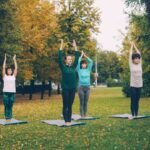



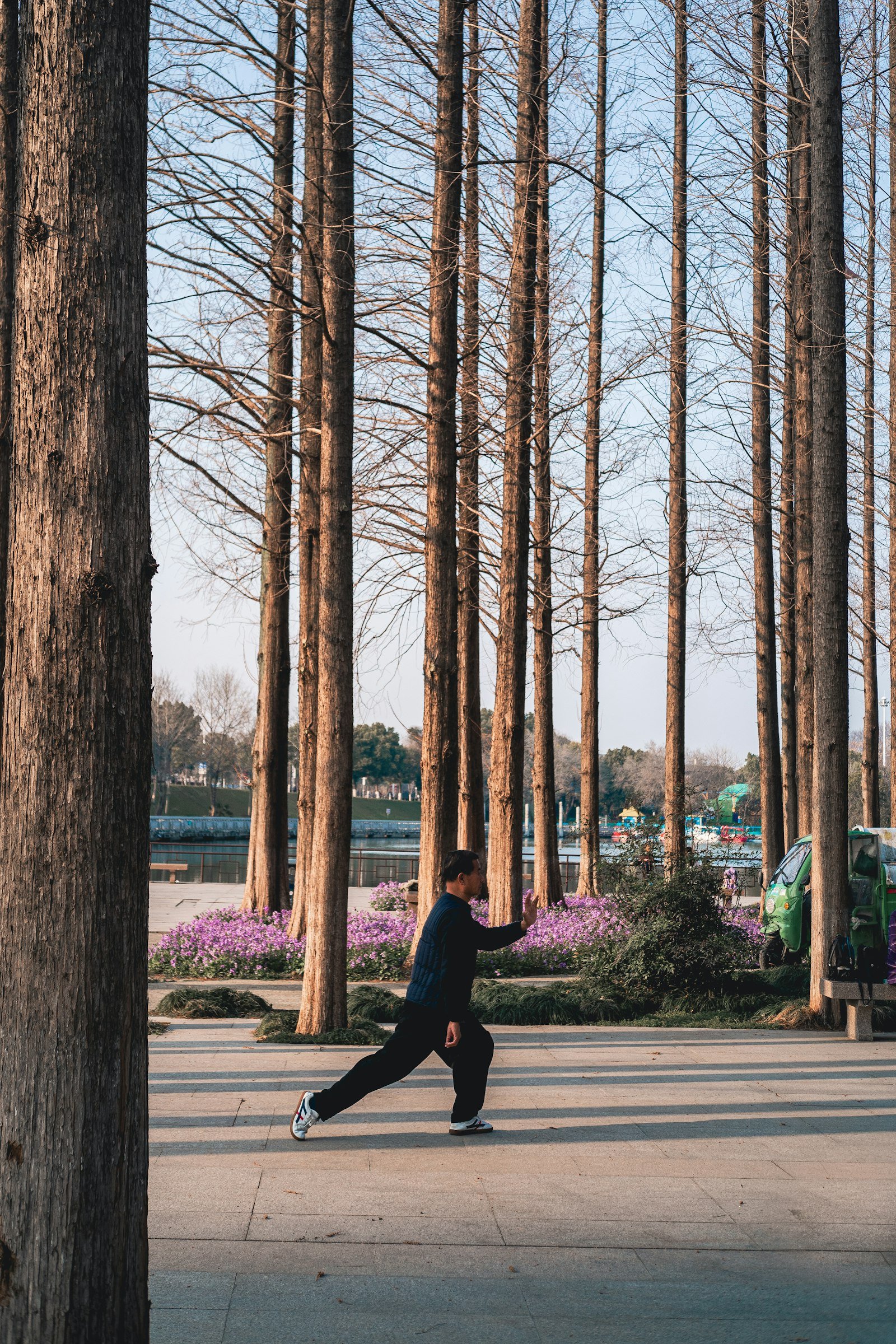
Walk through almost any park in China at sunrise and you will see them: small groups of people, many with silver hair, raising their arms slowly toward the sky, drawing an imaginary bow, bending and rising in unison. Many are practicing Baduanjin, a set of eight standing movements whose name means “eight pieces of brocade.” The name suggests that each movement is as fine and precious as a panel of embroidered silk.
Baduanjin is one of the oldest and most widely practiced forms of qigong, the family of Chinese mind-body exercises that link gentle movement, steady breathing and calm attention. Versions of it appear in encyclopedias from the Song dynasty, and a Daoist text from around 1150 describes an early form. By around 1300, an illustrated collection on self-cultivation showed all eight movements. Later legend credits General Yue Fei with teaching the routine to keep his soldiers strong, although historians think that story came along centuries afterward.
What makes Baduanjin interesting today is that modern researchers have started testing it with the same tools used to test medications. In early 2026, a year-long clinical trial published in the Journal of the American College of Cardiology found that this 800-year-old routine lowered blood pressure about as well as brisk walking. Reviews of dozens of other trials point to benefits for balance, sleep, mood and strength in older adults. Here is what the research shows and how you can start this week, with no equipment and about 15 minutes of your morning.
Key Takeaways
- Baduanjin is a traditional Chinese qigong routine of eight slow, standing movements that takes roughly 10 to 15 minutes and needs no equipment.
- In the 2026 BLESS trial of 216 adults with mildly raised blood pressure, practicing Baduanjin five days a week lowered office systolic pressure by about 5 mmHg compared with self-directed exercise, and the benefit lasted a full year.
- Baduanjin matched brisk walking for blood pressure benefits in that trial, making it a useful option for people who cannot or prefer not to walk briskly.
- A 2025 review of 40 studies in older adults linked regular practice to better standing and moving balance and lower fall-risk scores, with gains appearing after about 12 weeks.
- A 2026 review of 18 trials in adults over 60 found improvements in sleep quality, depressive symptoms, quality of life and grip strength.
What Is Baduanjin?
In Traditional Chinese Medicine, health depends on the smooth flow of qi, the vital energy that moves through the body’s channels, and on harmony between body, breath and mind. Qigong practices were developed to cultivate that flow. Baduanjin became one of the most popular because it is short, easy to remember and can be done almost anywhere, by people of nearly any age.
Each of the eight movements was traditionally linked to a particular organ system. Seen through a Western exercise lens, the routine blends gentle aerobic work, holds in a semi-squat stance, stretching of the spine, shoulders and hamstrings, and slow breathing that calms the nervous system, several jobs in one short session.
The Blood Pressure Trial That Made Headlines
The study that brought Baduanjin to cardiologists’ attention is known as BLESS (Baduanjin Lower Elevated Blood PreSsure Study). Researchers led by Dr. Jing Li of China’s National Center for Cardiovascular Diseases in Beijing recruited 216 adults aged 40 and older from seven communities. Everyone had a systolic (top number) blood pressure between 130 and 139 mmHg. That range is often called “high-normal” or stage 1, the zone where many people are told to watch their numbers and improve their lifestyle before medication is considered.
Participants were randomly assigned to one of three groups for a full year: Baduanjin practiced five days a week, brisk walking, or self-directed exercise on their own. The researchers measured blood pressure in the clinic and also with 24-hour monitors, which track pressure through daily life and sleep and give a more complete picture than a single reading.
Compared with the self-directed exercise group, the Baduanjin group had:
- About a 5 mmHg drop in office systolic blood pressure at three months, still present at one year.
- About a 3 mmHg drop in 24-hour systolic pressure, also sustained at one year.
- Results and safety comparable to brisk walking at the one-year mark.
A few millimeters might sound small, but at the population level it matters. The American College of Cardiology noted that the drop in office pressure was comparable to the reductions seen with some first-line blood pressure medications, and the journal’s editor-in-chief, Dr. Harlan Krumholz, described the effect size as similar to that of landmark drug trials. Just as encouraging, the benefit held for a full year, which suggests people found the routine easy enough to keep doing.
If you are working on your blood pressure from several angles, Baduanjin pairs well with dietary changes such as swapping regular salt for a potassium-rich salt substitute.
What the Research Shows About Baduanjin
| Study | Who was studied | Main findings |
|---|---|---|
| BLESS trial, JACC (2026) | 216 adults 40+ with systolic pressure of 130–139 mmHg, followed for one year | Office systolic pressure about 5 mmHg lower and 24-hour systolic about 3 mmHg lower than self-directed exercise; similar to brisk walking |
| Balance review, Frontiers in Public Health (2025) | 40 studies in adults aged 60+, including people with stroke, knee arthritis, osteoporosis and Parkinson’s | Better static and dynamic balance, faster sit-to-stand times and lower fall-risk scores; best results with 30–49 minute sessions, 5–7 times a week, for 12+ weeks |
| Older adults review, Frontiers in Public Health (2026) | 18 randomized trials, 1,527 adults aged 60+ | Improved sleep quality, fewer depressive symptoms, better quality of life, stronger grip, and reductions in BMI and waist size |
| Cancer review, Evidence-Based Complementary and Alternative Medicine (2021) | 10 randomized trials, 811 people living with cancer | Less cancer-related fatigue and better sleep scores; authors rated the evidence as low certainty and called for more trials |
Beyond Blood Pressure: Balance, Sleep and Mood
Steadier on Your Feet
Many Baduanjin movements are performed in a “horse stance,” a gentle semi-squat that builds strength in the thighs and hips, while others ask you to shift your weight, turn your head and rise onto your toes. These are exactly the skills that protect against falls. A 2025 review of 40 studies in older adults found that practice improved balance while standing still and while moving, sped up the sit-to-stand test (a common marker of leg strength), and lowered fall-risk scores. The authors suggested that gains begin after about 12 weeks and are strongest with sessions of 30 to 49 minutes, five to seven times a week. In practice, that often means doing the routine two or three times through in a session.
Baduanjin shares this strength with its better-known cousin. If you enjoy it, you may also like our guide to tai chi for balance and fall prevention.
Better Sleep and Brighter Mood
The slow, coordinated breathing at the heart of qigong appears to calm the stress response, and that may help explain findings on sleep and mood. A 2026 review of 18 randomized trials involving more than 1,500 adults over 60 found that Baduanjin improved sleep quality, eased depressive symptoms, and raised quality of life scores. Participants also gained grip strength, a simple measure that tracks closely with overall health as we age. For people living with cancer, an earlier review of 10 trials found less fatigue and better sleep, although those authors stressed that larger, better-designed studies are still needed.
For another movement-based approach to restful nights, see what research says about yoga for insomnia.
Why Researchers Think It Works
The likely explanation is that Baduanjin combines light, steady muscle work, which raises the heart rate much like a moderate walk, with long, relaxed breaths that shift the nervous system toward its “rest and digest” mode. Its focused attention may also lower stress over time. Traditional Chinese Medicine describes the same benefits in its own language: moving qi, calming the spirit (shen), and strengthening the kidneys and waist.
How to Practice the Eight Brocades
Stand with your feet about shoulder-width apart, knees soft, spine long, and shoulders relaxed. Breathe slowly through your nose. Repeat each movement six to eight times, moving smoothly with your breath, then move on to the next. The common English names are:
- Two Hands Hold Up the Heavens. Interlace your fingers, turn your palms upward, and press slowly toward the sky as you inhale. Lower your arms as you exhale. This lengthens the whole spine.
- Drawing the Bow to Shoot the Hawk. Step into a wide, gentle horse stance. Extend one arm to the side as if holding a bow while the other hand draws back the string. Turn your head to look past your extended hand. Switch sides.
- Separate Heaven and Earth. Raise one palm overhead while pressing the other palm down by your hip, stretching the sides of the body. Alternate.
- Wise Owl Gazes Backward. With your arms relaxed, slowly turn your head and gaze over one shoulder, then return to center. Alternate sides. Keep the movement small and comfortable.
- Sway the Head and Shake the Tail. From a horse stance with your hands on your thighs, shift your weight and lean gently from side to side in a slow arc.
- Two Hands Hold the Feet. Slide your hands down the backs of your legs as far as is comfortable, then roll back up slowly. Bend your knees as much as you need.
- Clench the Fists and Glare Fiercely. In a horse stance, punch slowly forward with one fist, eyes wide and focused, then draw it back. Alternate.
- Bouncing on the Toes. Rise onto the balls of your feet, pause, then lower your heels gently to the ground. Hold a chair if you need support.
Tips for Getting Started
- Learn by watching. Follow a video of the standardized “Health Qigong Baduanjin” routine, or join a local qigong or tai chi class, where teachers can correct your form.
- Aim for five days a week. That was the schedule used in the blood pressure trial. One round takes about 12 to 15 minutes; two or three rounds bring you into the range linked to balance benefits.
- Keep it comfortable. Bend your knees only as much as feels good, and make the movements smaller if needed. Baduanjin should feel calming, never strained.
- Mix it with other movement. Baduanjin works well alongside walking and a little strength training each week.
The Bottom Line
Baduanjin is a centuries-old treasure from Chinese tradition that modern science is finally putting to the test, and it is passing. A year-long trial published in a leading cardiology journal found that practicing the eight brocades five days a week lowered blood pressure about as much as brisk walking, while dozens of smaller studies point to better balance, sleep, mood and strength in older adults. It is free, gentle, takes about a quarter of an hour, and can be done in your living room or your local park. As one more tool in your overall approach to health, it may be one of the most graceful.
Frequently Asked Questions
Is Baduanjin the same as tai chi?
They are related but different. Both are traditional Chinese mind-body practices that use slow movement and breathing. Tai chi grew out of martial arts and involves a longer flowing sequence with many steps, while Baduanjin is a short set of eight mostly stationary movements that is easier to learn quickly.
How long does it take to notice results?
In the BLESS trial, the blood pressure drop was already visible at three months. Reviews of balance research suggest gains tend to appear after about 12 weeks of regular practice.
Can I do Baduanjin if I have limited mobility?
Yes. A seated version of the eight brocades exists, and the standing movements can be made smaller or done next to a sturdy chair for support. Several studies in the balance review included people recovering from stroke or living with knee arthritis or Parkinson’s disease.
Can Baduanjin replace my blood pressure medication?
No. It is best viewed as an addition to your overall plan. If you take blood pressure medication, keep taking it as prescribed and share your home readings with your practitioner, who can decide whether any adjustments make sense over time.
Safety note: Movements that involve bending forward or turning the head can cause light-headedness in people with very high or very low blood pressure, vertigo, or recent eye surgery. Keep these movements small, rise slowly, and hold a chair for the toe-raises if your balance is unsteady.
Sources
- Pu B, Zhang L, Sun Y, et al. Effect of Baduanjin on Blood Pressure Among Individuals With High-Normal Blood Pressure: A Multicenter, Open-Label, Blinded-Outcome Randomized Controlled Trial. Journal of the American College of Cardiology, 2026. https://www.jacc.org/doi/10.1016/j.jacc.2026.01.014
- American College of Cardiology. Ancient Mind-Body Practice Proven to Lower Blood Pressure in Clinical Trial (press release, February 18, 2026). acc.org
- ClinicalTrials.gov. Baduanjin Lower Elevated Blood PreSsure Study (NCT05397535). clinicaltrials.gov
- Yang Y, et al. Optimal exercise parameters of Baduanjin for balance in older adults: a systematic review and meta-analysis. Frontiers in Public Health, 2025;13:1541170. frontiersin.org
- Zhao L, Chong MC, Lee WL, et al. Effects of Baduanjin exercise on sleep quality, depressive symptoms, quality of life, and body composition in older adults: a systematic review and meta-analysis of randomized controlled trials. Frontiers in Public Health, 2026;14:1882039. doi.org/10.3389/fpubh.2026.1882039
- Kuo CC, et al. Clinical Effects of Baduanjin Qigong Exercise on Cancer Patients: A Systematic Review and Meta-Analysis on Randomized Controlled Trials. Evidence-Based Complementary and Alternative Medicine, 2021;2021:6651238. pmc.ncbi.nlm.nih.gov
- Baduanjin qigong: history and movements. Wikipedia
This article is for educational purposes and is not a substitute for personalized advice from a qualified health practitioner.