












Yoga began in India as a complete system for uniting body, breath and mind, and its teachers have long adapted postures for students who were older, stiff or recovering from injury. In the 20th century, the renowned teacher B.K.S. Iyengar popularized the use of blocks, straps, chairs and walls so that people with joint problems could practice safely. That idea of meeting the body where it is now sits at the heart of a growing body of research on yoga for one of the most common causes of pain and disability in older adults: knee osteoarthritis.
For years, the standard exercise advice for aching knees has been to strengthen the thigh muscles. That advice still holds. But a 2025 clinical trial from Australia found that yoga worked just as well for easing knee pain, and it brought a few extra benefits along the way.
Key Takeaways
- In a 2025 randomized trial of 117 adults with knee osteoarthritis, yoga reduced knee pain as much as a proven strengthening program.
- After 24 weeks, knee pain had dropped by an average of 24 points on a 100-point scale in the yoga group, compared with about 19 points with strength training.
- Yoga also showed modest advantages for stiffness, function, mood, walking speed and quality of life.
- An earlier trial of an unsupervised online yoga program improved physical function in people with knee osteoarthritis.
- A knee-friendly practice focuses on gentle strengthening, alignment, balance and relaxed breathing, with props to keep every pose comfortable.
Why Knees Respond to Gentle Movement
Osteoarthritis is not simply “wear and tear.” It involves the whole joint: cartilage, bone, the joint lining and the muscles and ligaments around it. Low-grade inflammation, weak thigh muscles, poor balance and stress can all make pain worse. Cartilage has no blood supply of its own and relies on movement to circulate the joint fluid that nourishes it, which is one reason gentle, regular activity tends to help rather than harm.
Yoga addresses several of these factors at once. Standing poses build strength in the quadriceps, hips and glutes. Slow transitions train balance and joint awareness. And the breathing and relaxation built into yoga may change how the nervous system processes pain.
The Research: Yoga Goes Head to Head With Strength Training
The 2025 Tasmanian trial
Researchers in Tasmania, Australia, with first author B.J. Abafita and colleagues including Dawn Aitken of the Menzies Institute for Medical Research, published their findings in JAMA Network Open in 2025. They randomly assigned 117 adults aged 40 and older (average age about 62) with painful knee osteoarthritis to either yoga or an evidence-based strengthening program.
Both groups followed the same schedule: two supervised sessions and one home session each week for 12 weeks, then three home sessions a week for another 12 weeks. The researchers wanted to know whether yoga would be “noninferior,” meaning no worse than strengthening, for reducing knee pain.
It was. On a 0 to 100 pain scale:
- Yoga: pain fell by 17.7 points at 12 weeks and 24.4 points at 24 weeks.
- Strengthening: pain fell by 16.7 points at 12 weeks and 18.6 points at 24 weeks.
Both reductions were large enough to matter in daily life. Yoga also showed modest extra gains in function, stiffness, depressive symptoms, walking speed and quality of life, and only mild side effects were reported in either group. The authors concluded that yoga is a safe and effective option, particularly for people who would like an alternative to conventional exercise.
Yoga from your living room
An earlier trial led by Professor Kim Bennell at the University of Melbourne, published in the Annals of Internal Medicine in 2022, tested a free, unsupervised online yoga program in 212 people with knee osteoarthritis. After 12 weeks, the yoga group improved more in physical function than a group given online education alone, with 60% reaching a meaningful improvement compared with 44% of controls. Pain did not differ between groups, and the benefits faded once people stopped practicing regularly. The lesson: yoga at home can help, and consistency is what keeps the gains.
Yoga vs. Strengthening: The 2025 Results
| Measure | Yoga | Strengthening |
|---|---|---|
| Drop in knee pain at 12 weeks (0-100 scale) | 17.7 points | 16.7 points |
| Drop in knee pain at 24 weeks | 24.4 points | 18.6 points |
| Function, stiffness, mood, walking speed | Modestly better | Improved |
| Side effects | Mild only | Mild only |
Source: Abafita et al., JAMA Network Open, 2025 (117 adults with knee osteoarthritis).
A Gentle, Knee-Friendly Yoga Sequence
This 20-minute routine draws on the kinds of poses commonly used in therapeutic yoga for knees. Move slowly, breathe through your nose, and stay in a range that feels comfortable. Mild muscle effort is fine; sharp or pinching knee pain is a signal to ease off.
- Seated breathing (2 minutes). Sit tall on a chair. Breathe in for a count of four and out for a count of six. Longer exhales help relax the nervous system.
- Seated knee extensions (1 minute per leg). Still seated, slowly straighten one leg, tighten the front of the thigh, hold for five breaths and lower. This mirrors classic physical therapy exercises for the quadriceps.
- Mountain pose (1 minute). Stand with feet hip-width apart, weight spread evenly, knees soft rather than locked. Feel your thigh muscles gently engage.
- Chair-supported chair pose (5 slow repetitions). With a sturdy chair behind you, bend your knees and sit your hips back as if about to sit, keeping knees in line with your toes. Hover, then stand. Go only as low as is comfortable.
- Supported warrior II (30 seconds per side). Hold the back of a chair for balance. Step your feet wide, turn one foot out and bend that knee a little, keeping it over the ankle. This builds hip and thigh strength.
- Tree pose at the wall (30 seconds per side). Rest a hand on the wall and place one foot against the opposite ankle or calf, never against the side of the knee. This trains balance.
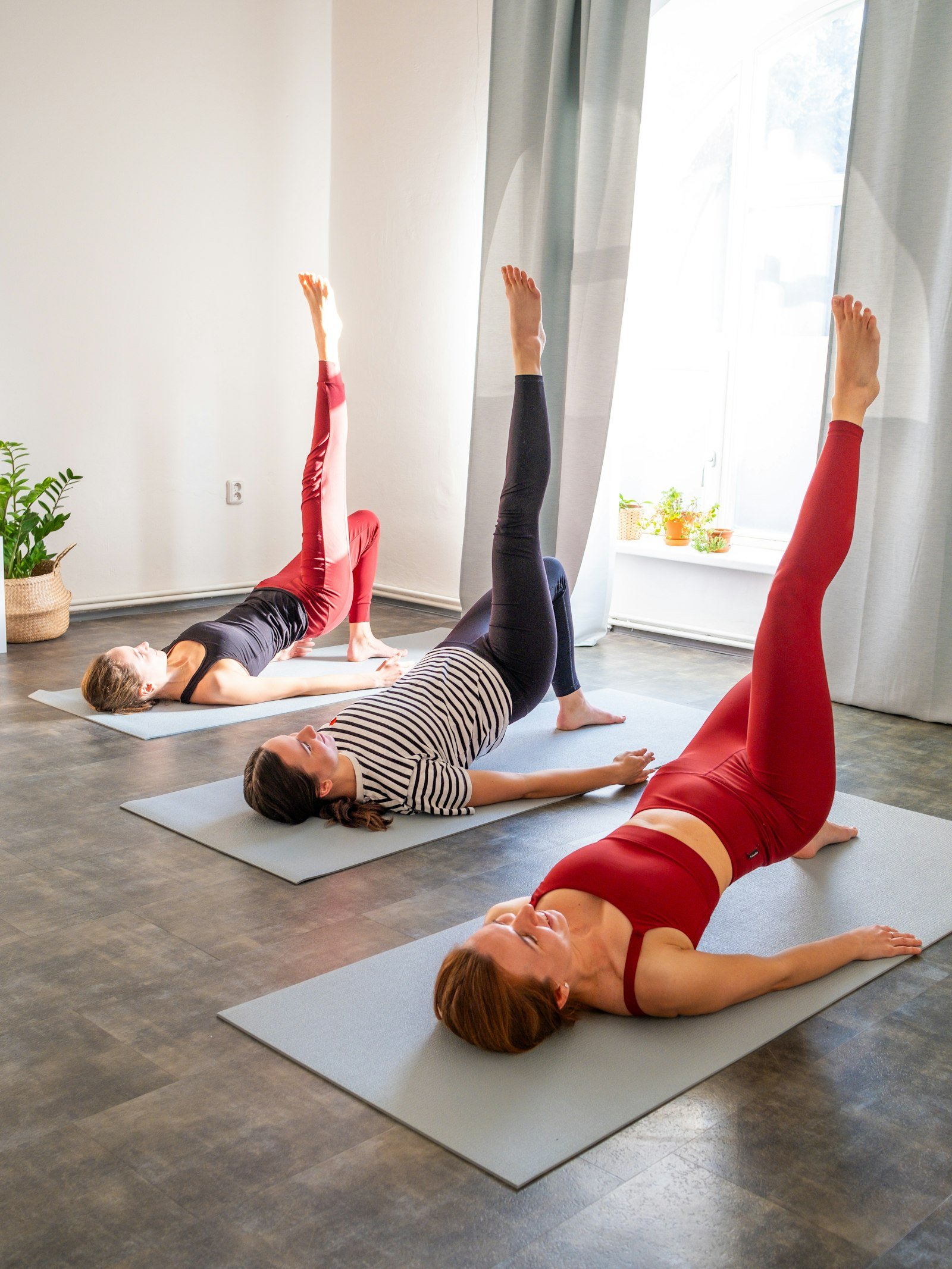
- Bridge pose (5 to 8 repetitions). Lie on your back with knees bent and feet flat. Press through your feet to lift your hips, hold for three breaths and lower slowly.
- Reclined leg stretch with a strap (1 minute per leg). Lying down, loop a strap or towel around one foot and lift the leg toward the ceiling, keeping a soft bend in the knee, to stretch the hamstrings.
- Relaxation (3 to 5 minutes). Rest on your back with a pillow under your knees, letting the breath slow and the body soften.
Aim for about three sessions a week, the schedule used in the 2025 trial. Skip or modify deep kneeling poses and full squats if they bother you; a folded blanket under the knees or a chair can make many poses more comfortable.
Pair Yoga With Other Natural Joint Support
Yoga fits beautifully into a broader, whole-person approach to joint health. Anti-inflammatory foods and spices can help, as described in our articles on turmeric for knee osteoarthritis and ginger for pain. If balance is a concern, tai chi is another gentle movement practice with strong research behind it. And if your back also aches, see our guide to yoga for chronic back pain.
The Bottom Line
Yoga has always been about adapting practice to the person. Now a well-designed 2025 trial shows that for people with knee osteoarthritis, a regular yoga practice can ease pain as effectively as a proven strengthening program, with added benefits for stiffness, mood and quality of life. If you enjoy yoga more than a gym routine, that matters, because the exercise you will keep doing is the one that helps most. Start gently, use props freely and make it a steady part of your week.
Frequently Asked Questions
Is yoga safe if my knees already hurt?
In the 2025 trial, people with painful knee osteoarthritis practiced yoga three times a week and reported only mild side effects. Choose gentle or therapeutic classes, use props and avoid forcing deep bends.
What style of yoga is best for knee arthritis?
Gentle hatha, Iyengar-style classes that use props, and chair yoga are good starting points. Very hot or fast-paced power classes may put more strain on the knees.
How soon might I notice a difference?
Pain had clearly improved by 12 weeks in the trial and kept improving through 24 weeks. Many people notice they feel looser and steadier after a few weeks.
Should I stop my strengthening exercises?
Not at all. Yoga and strength training are both effective, and many people enjoy combining them or alternating them through the week.
Safety note: If your knee is hot, red, badly swollen or suddenly unable to bear weight, or if you have had a recent knee replacement or injury, get it assessed before starting a new practice, and ask a qualified yoga therapist or physical therapist to help modify poses.
Sources
- Healio. Yoga noninferior to strength exercise for reducing osteoarthritis knee pain (on Abafita BJ, et al., JAMA Network Open, 2025).
- HMP Global Learning Network. Yoga found noninferior to strengthening exercises for knee osteoarthritis pain relief.
- University of Melbourne. Benefits found in online yoga for sufferers of knee osteoarthritis (Bennell KL, et al., Annals of Internal Medicine, 2022).
This article is for educational purposes and is not a substitute for personalized advice from a qualified health practitioner.





