






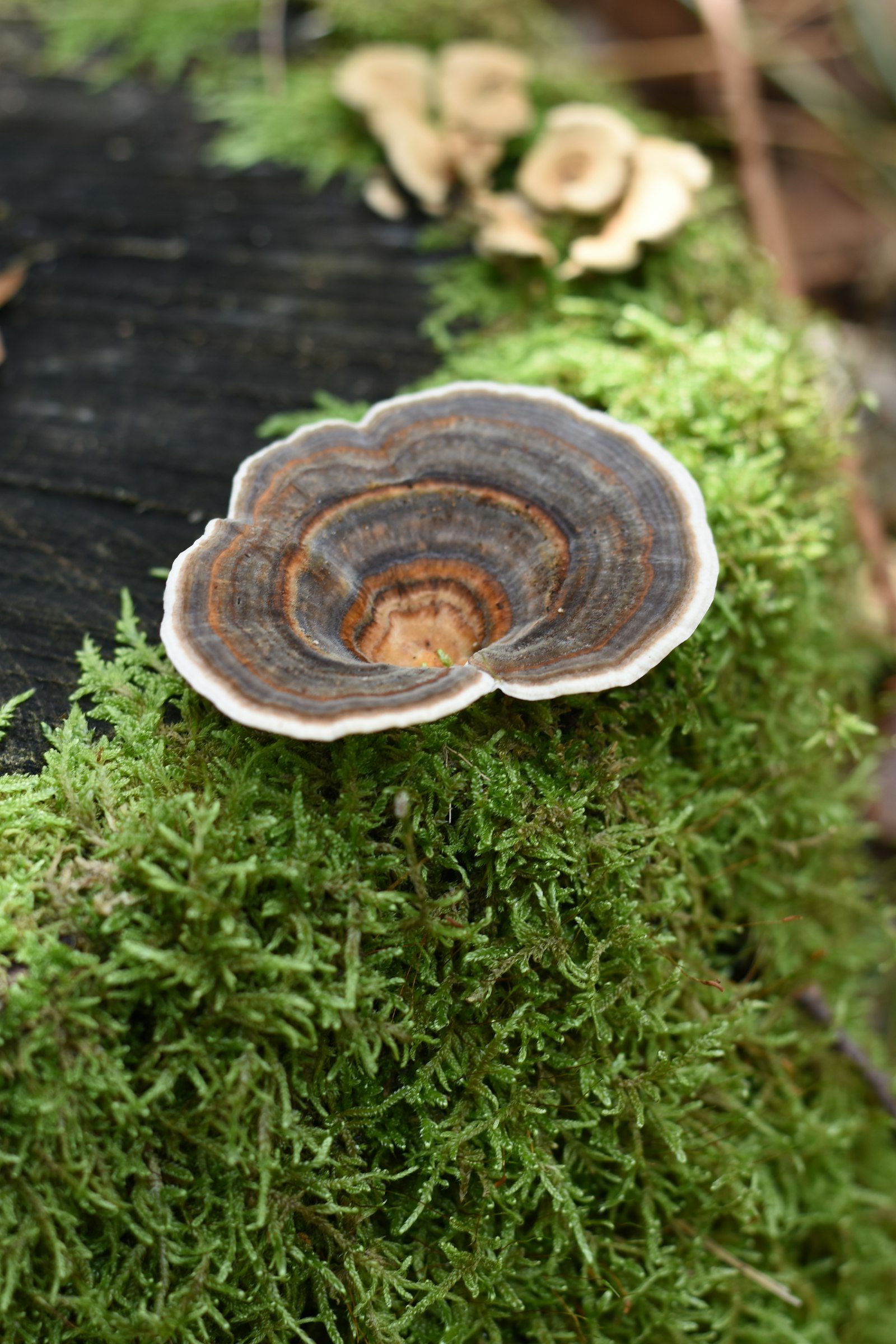
Walk through almost any hardwood forest and you will find it: thin, leathery fans of fungus stacked along a fallen log, banded in rings of brown, rust, cream, and blue-gray like the spread tail of a wild turkey. Most hikers walk right past it. Healers in China did not. Known there as Yun Zhi, or “cloud mushroom,” Trametes versicolor has been simmered into teas in traditional Chinese medicine for generations, where it was valued for strengthening the lungs and the body’s resilience. In Japan the same mushroom is called Kawaratake, the “mushroom by the riverbank.”
What makes turkey tail remarkable is that this folk remedy did not stay in the folk tradition. Since the mid-1970s, an extract of the mushroom called PSK has been an approved product used in cancer care in Japan, and thousands of patients have taken part in clinical trials of it. Here is what that research shows, where the evidence is strongest, and how people use this humble forest fungus today as part of a whole-person approach to cancer care.
Key Takeaways
- Turkey tail (Trametes versicolor) is a traditional Chinese medicinal mushroom; its extracts PSK (Japan) and PSP (China) are among the most studied natural products in cancer care.
- A 2007 meta-analysis of 8 randomized trials and 8,009 people with stomach cancer found that adding PSK to chemotherapy after surgery lowered the risk of death by about 12%.
- In colorectal cancer, a meta-analysis of 3 trials with 1,094 patients linked PSK to better 5-year survival (79.0% vs. 72.2%) and fewer recurrences.
- Turkey tail is studied as an addition to standard treatment, not a replacement, and it appears to work by supporting the immune system.
- Side effects in studies have been few and mild. Product quality varies widely, so choose carefully and keep your care team informed.
From Forest Remedy to Cancer Research
Mushrooms have a long place in Asian medicine. Reishi, shiitake, maitake, and turkey tail all appear in traditional formulas meant to “tonify” the body, strengthening its defenses rather than attacking a single symptom. That whole-system idea is exactly what drew modern researchers to them. Scientists in Japan isolated a protein-bound polysaccharide from turkey tail, named it PSK (also sold under the name Krestin), and began testing it alongside surgery and chemotherapy. Researchers in China developed a related extract, polysaccharopeptide, or PSP.
These large, complex sugar molecules do not act like chemotherapy drugs. Instead, research suggests they interact with immune cells, helping the body’s own defenses stay active during and after treatment that tends to wear them down. If you have read our look at mushrooms for immunity and healthy aging, you will recognize the theme: fungi carry compounds that “talk” to the immune system in ways few other foods do.
What the Clinical Research Shows
Stomach (Gastric) Cancer
The strongest evidence for turkey tail comes from stomach cancer, which is common in Japan and was the focus of many PSK trials. In one Japanese trial of 262 patients who had surgery and then chemotherapy, those who also took PSK had a 5-year survival rate of 73.0%, compared with 60.0% in those who did not.
A larger picture emerged in 2007, when researchers published a meta-analysis in Cancer Immunology, Immunotherapy that pooled 8 randomized controlled trials covering 8,009 patients who had their stomach cancer surgically removed. Adding PSK to post-surgery chemotherapy reduced the risk of death by about 12% (hazard ratio 0.88), and the results were consistent across the trials. The authors concluded that PSK immunochemotherapy improves survival after curative surgery for gastric cancer.
Colorectal Cancer
A 2006 meta-analysis led by Junichi Sakamoto and colleagues on behalf of the Japanese Society for Cancer of the Colon and Rectum gathered 3 centrally randomized trials with 1,094 patients, each followed for at least five years after surgery. Patients who received PSK along with their chemotherapy had a lower risk of death (ratio 0.71) and a lower risk of the cancer returning (ratio 0.72) than those on chemotherapy alone. According to the U.S. National Cancer Institute’s summary, 5-year survival was 79.0% with PSK versus 72.2% without it. Smaller Japanese studies, including one in patients over age 70, pointed in the same direction.
Lung and Breast Cancer
Evidence in other cancers is earlier-stage but encouraging. A systematic review of 28 studies on PSK in lung cancer found that all five nonrandomized controlled trials reported longer median survival in people taking PSK, and the randomized trials typically used 3 grams of PSK daily alongside chemotherapy. In breast cancer, research has mostly measured immune markers rather than survival. A small phase 1 trial published in 2012 by Torkelson and colleagues, in women who had completed standard breast cancer treatment, was designed to test the safety of turkey tail and track its effects on the immune system, rather than to measure survival.
The Evidence at a Glance: Turkey Tail Extract (PSK) in Cancer Care
| Cancer type | Type of evidence | Key finding |
|---|---|---|
| Stomach | Meta-analysis, 8 randomized trials, 8,009 patients (2007) | About 12% lower risk of death when PSK was added to chemotherapy after surgery |
| Stomach | Randomized trial, 262 patients | 5-year survival 73.0% with PSK vs. 60.0% without |
| Colorectal | Meta-analysis, 3 randomized trials, 1,094 patients (2006) | 5-year survival 79.0% vs. 72.2%; fewer recurrences |
| Lung | Systematic review of 28 studies | All 5 nonrandomized controlled trials reported longer median survival |
| Breast | Early-phase trials | Studies focused on immune markers; survival not yet tested |
Sources: National Cancer Institute PDQ summary on medicinal mushrooms; Cancer Immunology, Immunotherapy (2006, 2007).
How Turkey Tail May Help: A Whole-Body View
Traditional medicine has always seen cancer recovery as more than removing a tumor. It involves rebuilding strength, appetite, sleep, and the body’s natural defenses. Turkey tail fits this view well. Its polysaccharides appear to support the activity of immune cells that surgery, chemotherapy, and radiation can suppress. That may explain why the benefits in trials showed up mainly when PSK was combined with conventional treatment after surgery, a period when the immune system’s ability to find stray cancer cells matters a great deal.
This partnership approach is the heart of integrative oncology, where natural therapies are layered on top of standard care to support the whole person. Turkey tail sits comfortably beside the other pillars of that approach: a fiber-rich diet (see our post on fiber, whole grains, and colorectal cancer), regular movement (the landmark exercise trial in colon cancer survivors is a must-read), and time in nature, as in the Japanese practice of forest bathing.
What About Other Medicinal Mushrooms?
Reishi (Ganoderma lucidum), the “mushroom of immortality” in Chinese tradition, is the other famous cancer-support mushroom. Its human research is thinner than turkey tail’s, but clinical trials have found reishi products generally well tolerated. In one Japanese study of people with colorectal adenomas (precancerous polyps), those taking 1.5 grams a day of a reishi mycelium extract for 12 months saw their number of adenomas shrink slightly, while the number grew in the comparison group. A small lung cancer trial, on the other hand, found no clear change in immune measures. Reishi is promising, but turkey tail remains the mushroom with the deepest clinical record.
How to Use Turkey Tail Wisely: Practical Steps
- Bring it to your care team first. Turkey tail is researched as a companion to treatment. Tell your oncology team or integrative practitioner what you plan to take so it can be timed around your chemotherapy, radiation, or surgery.
- Know the difference between PSK and store products. PSK is a specific, standardized extract made in Japan. Most supplements sold in North America are different preparations, and Memorial Sloan Kettering Cancer Center notes that many over-the-counter products are not standardized.
- Look for a hot-water extract with tested beta-glucans. Traditional use relied on long simmering, which pulls the polysaccharides out of the tough fungus. Choose products that state the extraction method and list a measured polysaccharide or beta-glucan content, ideally with third-party testing.
- Use research doses as a guide, not a goal. Many PSK trials used about 3 grams per day. Supplement strengths vary, so follow the product label and your practitioner’s advice rather than converting doses yourself.
- Try the traditional tea. Dried turkey tail can be simmered gently for an hour or more to make an earthy, mild tea, the way it has been prepared in China for centuries. It pairs well with ginger or a slice of dried citrus peel.
- Do not forage unless you are an expert. Several look-alike bracket fungi grow in the same places. Buy from reputable suppliers instead.
- Keep the foundations strong. Mushrooms work best on top of good food, daily movement, restful sleep, and stress relief, not in place of them.
The Bottom Line
Turkey tail is one of the clearest examples of traditional plant and fungal medicine earning a place in modern cancer research. Decades of Japanese trials, involving thousands of patients, show that the turkey tail extract PSK, taken alongside standard treatment after surgery, is linked to longer survival in stomach and colorectal cancer. Evidence in lung and breast cancer is earlier but encouraging. It is not a cure and is not meant to stand alone, but as one thread in a whole-person plan, this colorful forest mushroom deserves a thoughtful conversation with your care team.
Frequently Asked Questions
Can turkey tail cure cancer?
No. The research shows turkey tail extract may improve outcomes when it is added to standard cancer treatment, especially in stomach and colorectal cancer. It has not been shown to cure cancer on its own, and the U.S. Food and Drug Administration has not approved it as a cancer treatment.
Is turkey tail the same as PSK?
Not exactly. PSK is a specific standardized extract of turkey tail developed and used in Japan. PSP is a related extract from China. Supplements sold elsewhere come from the same mushroom but are made in different ways, so their content can differ from what was studied.
What side effects does turkey tail have?
Few side effects have been reported in PSK studies. Memorial Sloan Kettering lists rare effects such as dark-colored stools and darkening of the fingernails, along with mild blood-count and digestive changes in people also on chemotherapy, which may come from the chemotherapy itself.
Can I just eat turkey tail mushrooms?
Turkey tail is too tough and leathery to eat like a culinary mushroom. Traditionally it is simmered into a tea or decoction, and today it is most often taken as a hot-water extract in capsules or powder.
Is turkey tail useful for cancer prevention?
The clinical research has focused on people already being treated for cancer, not on prevention. For lowering risk, the best-supported natural steps remain a plant-rich, high-fiber diet, regular physical activity, a healthy weight, and avoiding tobacco.
Safety note: Memorial Sloan Kettering advises that pregnant or breastfeeding women avoid turkey tail until safety data are available, and notes that it may interact with some medications. If you are in active cancer treatment, share any mushroom supplement with your oncology team so it can be coordinated with your therapy.
Sources
- National Cancer Institute. Medicinal Mushrooms (PDQ®), Health Professional Version. Updated November 2024.
- Efficacy of adjuvant immunochemotherapy with polysaccharide K for patients with curative resections of gastric cancer. Cancer Immunology, Immunotherapy. 2007;56(6):905-911.
- Sakamoto J, Morita S, Oba K, et al. Efficacy of adjuvant immunochemotherapy with polysaccharide K for patients with curatively resected colorectal cancer: a meta-analysis of centrally randomized controlled clinical trials. Cancer Immunology, Immunotherapy. 2006;55(4):404-411.
- Torkelson CJ, Sweet E, Martzen MR, et al. Phase 1 Clinical Trial of Trametes versicolor in Women with Breast Cancer. ISRN Oncology. 2012;2012:251632.
- Memorial Sloan Kettering Cancer Center. Coriolus Versicolor (About Herbs). Updated April 2026.
This article is for educational purposes and is not a substitute for personalized advice from a qualified health practitioner.





