









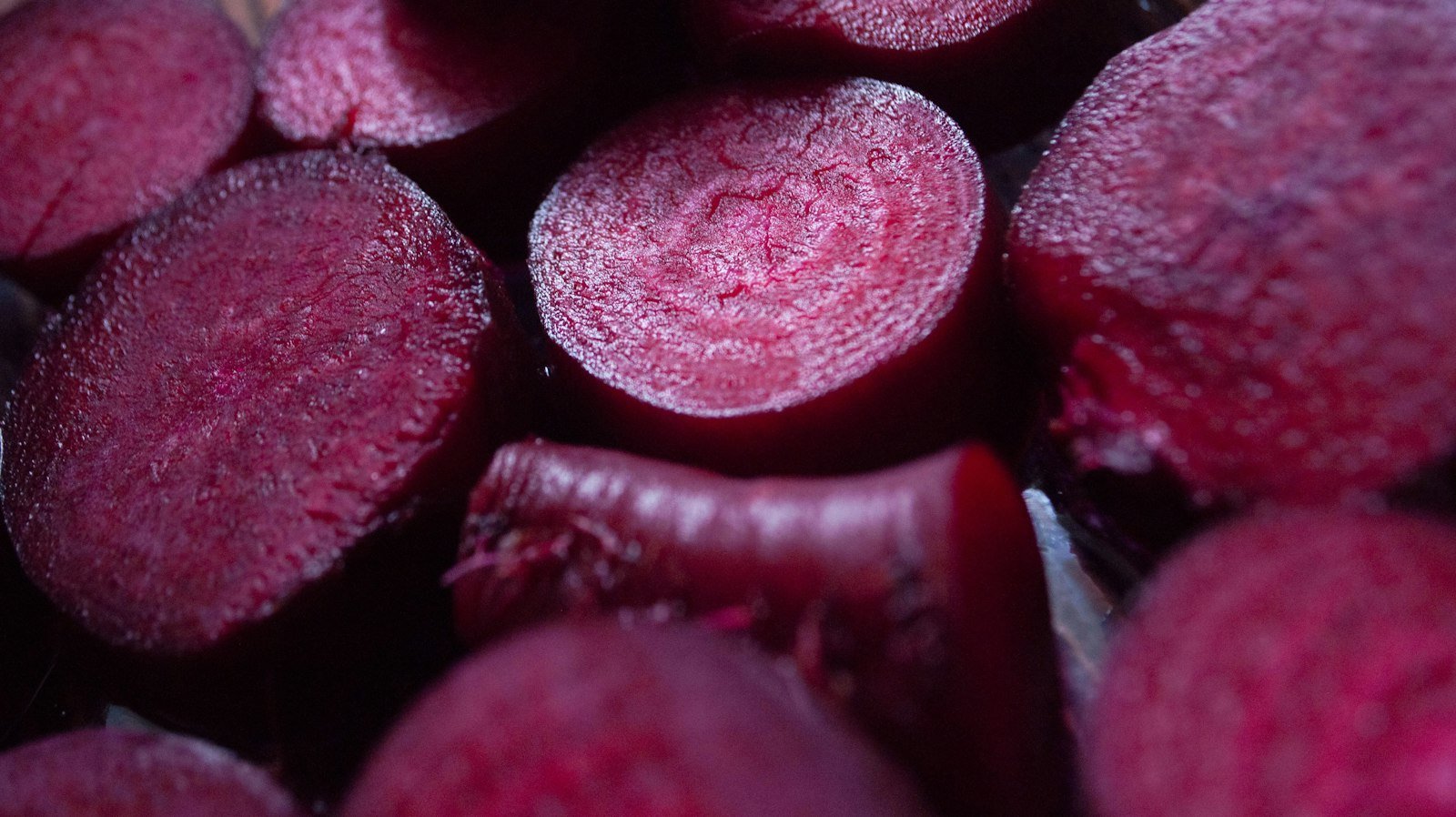
Beets have been part of human diets since ancient times. Early Mediterranean farmers grew them mostly for their leafy greens, and the deep-red root became a staple later, in everything from Eastern European borscht to the pickled beets of American farm kitchens. Folk healers often used beet juice as a “blood builder” because of its color.
The color turned out to be a coincidence, but the idea that beets help the blood was not far off. Beetroot is one of the richest food sources of dietary nitrate, a natural compound the body turns into nitric oxide, a molecule that relaxes blood vessels. Several clinical trials have now shown that a daily glass of beetroot juice can lower blood pressure.
Key Takeaways
- Beets and leafy greens are rich in natural nitrate, which the body converts into nitric oxide, helping arteries relax and widen.
- In a 2015 Queen Mary University of London trial, 250 mL of beetroot juice daily lowered blood pressure by about 8/4 mmHg in four weeks in people with high blood pressure.
- The same trial found about a 20% improvement in blood vessel function and about a 10% drop in arterial stiffness.
- Friendly bacteria on your tongue are an essential step in the process. A 2025 University of Exeter study found that beetroot juice shifted these bacteria in older adults and lowered their blood pressure.
- The effect fades when you stop, so beets work best as a steady daily habit.
From Beet to Blood Vessel: The Nitrate Pathway
The way beets work is one of the best examples of the body acting as a connected whole, with a little help from its microbes.
- You eat or drink nitrate. Beets, arugula, spinach, celery, and other leafy greens are naturally high in it.
- Your body recycles it into saliva. After nitrate is absorbed, about a quarter of it is pulled from the blood by your salivary glands and released back into your mouth.
- Mouth bacteria do the key step. Certain bacteria living on the back of the tongue convert nitrate into nitrite. Human cells cannot do this well on their own.
- Nitrite becomes nitric oxide. Once swallowed and absorbed, nitrite is turned into nitric oxide in the blood and tissues, especially where oxygen is low.
- Arteries relax. Nitric oxide signals the muscle in artery walls to loosen, so blood flows more easily and pressure falls.
This pathway becomes more important as we age, because the inner lining of our blood vessels naturally makes less nitric oxide over time.
What the Research Shows
The Queen Mary University of London trial
In 2015, a team led by Professor Amrita Ahluwalia published a double-blind trial in the journal Hypertension. They recruited 64 adults aged 18 to 85 with high blood pressure. Half were already taking blood pressure medicine but had not reached their target. The other half were not yet on medicine.
For four weeks, participants drank 250 mL (about one cup) of beetroot juice a day. One group had regular, nitrate-rich juice. The other had beetroot juice with the nitrate removed, so it looked and tasted the same. The nitrate group’s blood pressure dropped by about 8/4 mmHg, enough to bring many into the normal range. Their blood vessels widened about 20% better and their arteries became about 10% less stiff. The placebo group saw no change. Two weeks after the juice stopped, blood pressure returned to where it had been.
The bigger picture
A 2013 review in the Journal of Nutrition pooled 16 trials and found that nitrate and beetroot juice lowered systolic (top-number) blood pressure by an average of about 4.4 mmHg. That may sound modest, but at a population level, even a few points lower is linked with fewer strokes and heart attacks.
The mouth bacteria discovery
In 2025, researchers at the University of Exeter, including Professors Anni Vanhatalo and Andy Jones, studied 39 younger adults and 36 adults in their 60s and 70s. Each person took a concentrated beetroot juice shot twice a day for two weeks and a nitrate-free version for another two weeks. In the older group, who started with higher blood pressure, the nitrate-rich juice lowered blood pressure and the placebo did not. Their mouth bacteria also changed: helpful Neisseria rose and Prevotella fell. The study appeared in Free Radical Biology and Medicine.
Evidence Snapshot: Beetroot and Dietary Nitrate
| Study | Who and how | Result |
|---|---|---|
| Kapil et al., Hypertension, 2015 | 64 adults with high BP; 250 mL juice daily for 4 weeks | BP down ~8/4 mmHg; ~20% better vessel dilation; ~10% less arterial stiffness |
| Siervo et al., J Nutrition, 2013 | Review of 16 trials | Systolic BP down ~4.4 mmHg on average |
| Vanhatalo, Jones et al., Free Radic Biol Med, 2025 | 36 older and 39 younger adults; juice shots twice daily for 2 weeks | BP lowered in older adults; healthier shift in mouth bacteria |
Sources listed below.
Protect the Bacteria That Do the Work
Because tongue bacteria are a key link in the chain, what you do to your mouth matters. In a 2013 study, the same Queen Mary team found that when healthy volunteers used a strong antiseptic mouthwash for a week, their nitrite levels fell and their blood pressure rose slightly. Killing off the good bacteria broke the nitrate pathway.
This is a striking reminder that health is a whole-body system. Gentle oral care that supports, rather than wipes out, your mouth’s microbes may also support your heart. Brushing, flossing, and traditional tools like the miswak chewing stick clean your teeth without sterilizing your whole mouth.
How to Add Beets to Your Day
- Start with one glass. The London trial used 250 mL (about 1 cup) of beetroot juice a day. Choose 100% beet juice with no added sugar, or make your own.
- Try concentrated shots. If a full glass is too much, small beet “shots” supply a similar amount of nitrate in a few sips.
- Eat whole beets too. Roast, grate raw into salads, or blend into soups like borscht. Whole beets add fiber, though cooking in water can leach out some nitrate.
- Load up on leafy greens. Arugula (rocket), spinach, lettuce, Swiss chard, and celery are also rich in nitrate.
- Make it a daily habit. Benefits fade within days of stopping, so steady intake matters more than big amounts.
- Mix it into a juice you enjoy. Beet blends well with apple, carrot, ginger, and lemon. For tips on enjoying juice in a balanced way, see our juicing guide.
Build a Whole Blood-Pressure Routine
Beets work well alongside other natural approaches. Try pairing them with hibiscus tea and garlic, a few minutes of isometric exercise like wall sits, and steadier blood sugar, which, as we explored in our article on insulin resistance, plays a bigger role in blood pressure than many people realize.
The Bottom Line
Folk healers called beets a blood tonic, and modern science has found a real reason why. The natural nitrate in beetroot, with help from friendly mouth bacteria, becomes nitric oxide that relaxes the arteries. A daily glass of beet juice lowered blood pressure by about 8/4 mmHg in a well-designed trial, and improved how blood vessels work. It is an easy, food-based addition to a heart-healthy lifestyle, as long as you keep it up.
Frequently Asked Questions
How fast does beetroot juice work?
Blood pressure can begin to drop within a few hours of a single glass, peaking around 3 hours later. In trials, steady daily intake kept pressure lower over weeks.
Why is my urine pink after eating beets?
This is called beeturia. It comes from the beet pigment betanin and is harmless for most people.
Isn’t nitrate bad for you?
The concern about nitrates mostly involves processed meats, where nitrites are added and can form harmful compounds during high-heat cooking. Nitrate from vegetables comes packaged with vitamin C and polyphenols, which help steer it toward beneficial nitric oxide.
Can I take beet juice with my blood pressure medicine?
In the London trial, half the participants were already on medicine and still benefited. Because the effects can add up, keep track of your readings at home and share them with your practitioner.
A quick note: Beets are high in oxalates, so people with a history of kidney stones may want to keep portions moderate. If you take nitrate heart medicines or erectile dysfunction drugs, ask your practitioner before adding concentrated beet shots, since all of these widen blood vessels.
Sources
- Kapil V, et al. Dietary nitrate provides sustained blood pressure lowering in hypertensive patients: a randomized, phase 2, double-blind, placebo-controlled study. Hypertension, 2015;65:320-327. https://doi.org/10.1161/HYPERTENSIONAHA.114.04675
- Queen Mary University of London. Daily beetroot juice lowers blood pressure, scientists find (2015): https://www.qmul.ac.uk/media/news/2015/smd/daily-beetroot-juice-lowers-blood-pressure-scientists-find.html
- Siervo M, Lara J, Ogbonmwan I, Mathers JC. Inorganic nitrate and beetroot juice supplementation reduces blood pressure in adults: a systematic review and meta-analysis. Journal of Nutrition, 2013. https://eprints.ncl.ac.uk/201341
- University of Exeter. Beetroot juice lowers blood pressure in older people by changing oral microbiome (2025): https://news.exeter.ac.uk/faculty-of-health-and-life-sciences/beetroot-juice-lowers-blood-pressure-in-older-people-by-changing-oral-microbiome/
- Kapil V, et al. Physiological role for nitrate-reducing oral bacteria in blood pressure control. Free Radical Biology and Medicine, 2013. https://pmc.ncbi.nlm.nih.gov/articles/PMC3605573/
This article is for educational purposes and is not a substitute for personalized advice from a qualified health practitioner.